The Rusty Blackbird Hot
YEAr Three
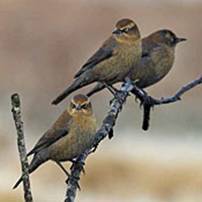
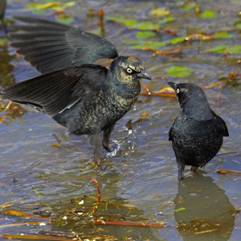
Last Year, Birders throughout the country scoured the countryside for
wintering Rusty Blackbirds to help us understand their distribution and find
important local concentrations (hotspots).
We learned a lot (see http://nationalzoo.si.edu/ConservationAndScience/MigratoryBirds/Research/Rusty_Blackbird/blitz_results.cfm).
But there is much more to learn.
We want to blitz for several years to both locate more hotspots and determine how stable the already discovered hot
spots are from year to year. Already,
the information gained is being used to implement research and conservation
efforts!
With your help….
The “Rusty Blackbird Third Times a Charm Blitz”
will be bigger and better than Blitz One and Two.
Why a Blitz? The
Rusty Blackbird has been steeply declining, with estimates of an 85-99% population drop over the past 40
years. Although the cause for this
alarming decline is not known, winter habitat loss and degradation are likely
candidates. Rusties are getting scarce
and patchy in their winter distribution, making it difficult focus research and
management we need to save the species. Collaborating
with Cornell Laboratory of Ornithology's and National Audubon Society’s e-Bird
project, we are enlisting the power of the birding public (you!) to help locate
local, but predictable wintering concentrations of Rusty Blackbirds. We are mobilizing an all out
"blitz" to locate Rusty Blackbirds and create a map of wintering Rusty Blackbird "hot spots"
that will help focus research, monitoring and conservation attention..
Who?
Birders from all
of the Rusties’ winter range (see below).
And for out- of -range northerners: We
will be developing opportunities for you to travel south and hit up critically
under covered states in the core of the Rusties winter range
What?
During a single 16-day period, volunteers
will search for Rusty Blackbirds in any locations and habitats deemed as
potentially suitable for wintering Rusty Blackbirds, particularly flocks or
concentrations (e.g., dozens or even hundreds of birds). Areas of concentration
will be revisited in the future to determine if they are indeed Rusty Blackbird
hot spots.
When? January
29 thru
Where? We are focusing on the following states known to comprise the
Rusty Blackbird winter range: Alabama,
Arkansas, Delaware, Florida, Georgia, Illinois, Indiana, Iowa, Kansas, Kentucky,
Louisiana, Maryland, Mississippi, Missouri,
New Jersey, North Carolina, Ohio, Oklahoma, Pennsylvania, South
Carolina, Tennessee, Texas (east), Virginia,
and West Virginia.
How? It’s simple! Use
whatever you like – your data base of previous sightings, birding intuition,
local legend, or local knowledge – to search the most likely places for wintering
Rusty Blackbirds. You can go wherever
you like, whenever you like, and as often as you like anytime between the dates
of 29 January –
Additional Information: We
will soon post additional instructions and information on identification,
habitat preferences, etc., on the
Information and
instructions will also be available on Cornell Laboratory of Ornithology's
e-Bird site: ebird.org
BE SURE TO
SAVE THE DATES!!!
JANUARY 29 –
Sponsored
by International Rusty Blackbird Technical
Working Group Cornell Laboratory of Ornithology’s and
National Audubon Society’s eBird